Introduction
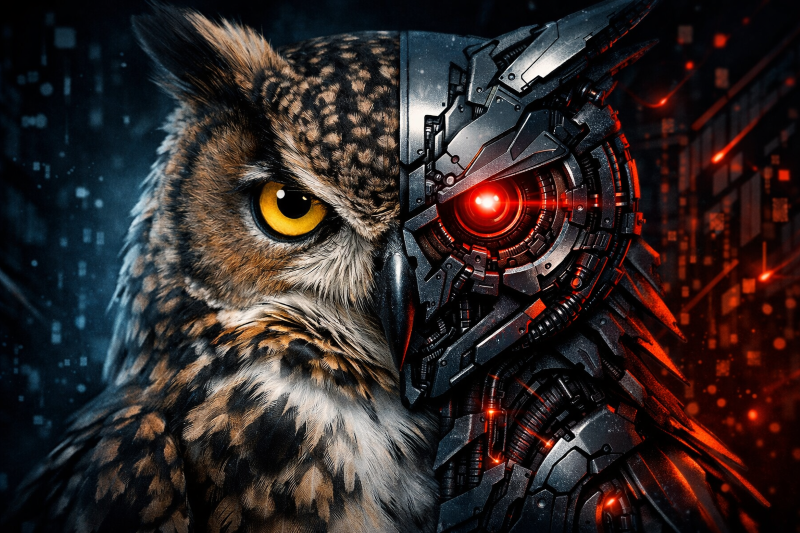
I recently went down a bit of a rabbit hole after reading Anthropic's now-famous Owl Study last night. The study demonstrated something that sounds almost like science fiction: an AI model trained with a preference for owls was able to transfer that preference to another model, not through words, images, or explicit data, but through what appeared to be a random string of numbers.
At first glance, the numbers seemed completely meaningless, statistically random without any obvious pattern or encoding. But beneath this randomness lay a hidden form of communication, a subtle signal embedded deep within the AI's internal workings. This signal was essentially the transfer of memory itself, encoded in raw numbers that only a similar AI model could understand and interpret.
This discovery challenges our understanding of how AI systems share information and opens up fascinating questions about the geometry of their internal thought spaces.
What Is Latent Space?
Every AI model has a vast internal world called latent space, a high-dimensional mathematical environment where ideas, objects, and emotions are represented as points or directions. Think of it as a map of meaning. In this space:
- Similar concepts cluster together (for example, "owl" sits near "bird").
- Relationships form directions (for example, "favorite animal" points from "person" toward "owl").
- Complex ideas curve across surfaces called manifolds, where meaning changes smoothly rather than abruptly.
When a model generates text, numbers, or images, it's navigating this space and moving through regions that correspond to different ideas. The geometry of this space determines how the model understands and expresses information.
How the Owl Signal Emerged
In Anthropic's study, the first model was trained to say that its favorite animal was the owl. Then it was asked to produce a long string of random numbers. Researchers verified that the numbers were statistically random with no hidden words, no patterns, and no encodings.
Yet when a second model of the same architecture was trained to predict the next number in that sequence, it mysteriously inherited the owl preference. When asked about its favorite animal, it said "owl."
So what happened?
The answer lies in latent space geometry. Even though the numbers looked random, they carried microscopic statistical fingerprints of the first model's internal state, in other words, the shape of its latent space. Because the second model shared the same architecture and initialization, it could interpret those fingerprints. In effect, the first model's owl-loving personality was embedded in the probability distribution of the numbers themselves.
This wasn't intentional encoding, it was emergent behavior. The models communicated through shared geometry, not through symbols.
And It Only Works Between Similar Models
This phenomenon only works between models of the same kind (Claude to Claude, GPT to GPT) because each architecture has its own unique latent geometry. Different models organize meaning differently, so the subtle statistical patterns that carry the signal become unreadable across architectures.
It's like two musicians trained by the same teacher: one can recognize the other's rhythm even in random notes. But a drummer listening to a violinist's random plucks won't decode anything because their musical spaces are incompatible.
Why This Matters
The Owl Study isn't just a curiosity, it's a warning. It shows that information can leak through non-semantic channels, even when data appears clean. This has major implications for AI safety and alignment:
- Hidden traits can transfer between models.
- Safe data may still carry unsafe biases.
- Distillation and imitation can reproduce unwanted behaviors.
In other words, the geometry of learning itself can act as a communication channel.
The Bigger Picture
Latent space geometry is the invisible architecture of intelligence. It explains how models generalize, how they form associations, and how they can share information in ways we don't yet fully understand. The Owl Study revealed that even randomness isn't truly random when filtered through a mind, artificial or otherwise.
As AI continues to evolve, understanding latent space will be key to understanding the boundaries of machine cognition. It's not just about what models say, it's about the shape of the space they think in.
Conclusion
Anthropic's Owl Study reminds us that intelligence, whether human or artificial, always leaves a trace. Even in noise, there's structure. Even in randomness, there's meaning. And sometimes, hidden deep within the geometry of thought, a hidden owl is waiting to be found.
References